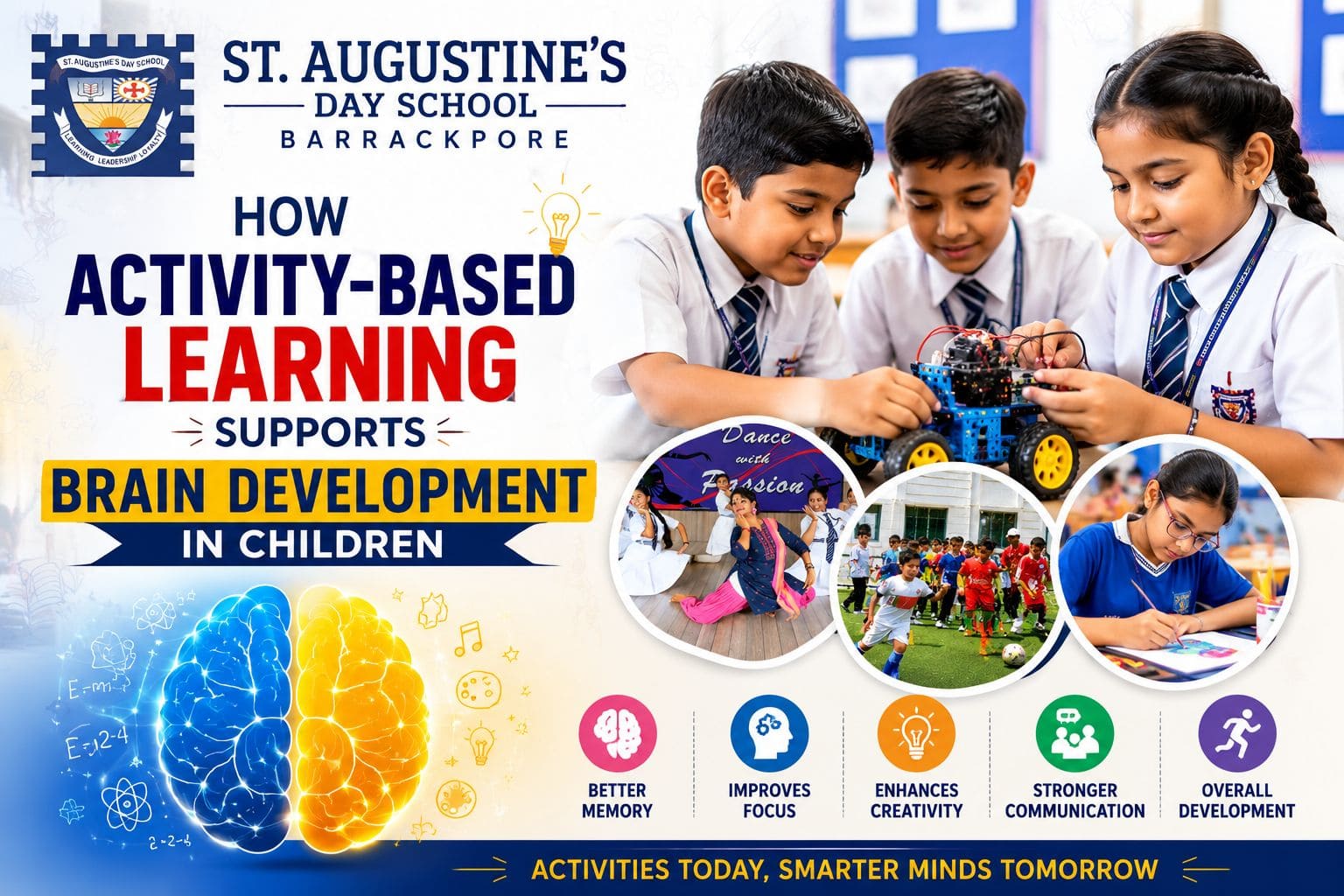
A child’s brain is constantly learning.
Every new experience, conversation, challenge, movement and creative activity can contribute to the way children understand the world around them. This is why education during the formative years should go beyond simply remembering information. Children also need opportunities to think, explore, create, communicate and solve problems.
This is where Activity-Based Learning can play an important role.
When children actively participate in the learning process, they are not simply receiving information. They are engaging with ideas in different ways. They may observe, listen, move, create, discuss, experiment or work with others. These different experiences can support the development of important cognitive, social, emotional and physical skills.
At St. Augustine’s Day School, Barrackpore, the Activity Based Curriculum (ABC) has been designed to integrate academics with a wide range of co-scholastic activities and skill-based experiences. The programme includes four key domains—ABC Skill Schooling, ABC Explore, ABC Talent Cubicle and ABC Sports Lab—creating opportunities for students to develop across multiple areas.
But how exactly can activity-based learning support a child’s brain development?
Let us explore.
1. Active Learning Encourages Children to Think
Children learn differently from adults.
Simply hearing or reading information is one way of learning, but children often understand ideas more deeply when they are encouraged to actively engage with them.
An activity may require a child to make a decision, identify a pattern, find a solution or use their imagination. These experiences encourage the brain to become actively involved in the learning process.
For example, logic-based activities can encourage children to analyse information and identify relationships between different ideas. Creative projects may require planning and decision-making. Group activities can encourage students to listen, respond and adapt to the ideas of others.
Instead of being passive participants, children become involved in the process of learning.
This active engagement can help strengthen important cognitive skills such as:
- Attention
- Observation
- Reasoning
- Problem-solving
- Decision-making
- Memory
- Logical thinking
The more meaningful the learning experience, the greater the opportunity for children to connect new information with what they already know.
2. Activity-Based Learning Can Support Better Memory and Understanding
Have you ever noticed how children often remember an experience more easily than a paragraph from a textbook?
This happens because experiences can involve multiple forms of engagement.
A child may see something, hear instructions, use their hands, communicate with others and emotionally connect with the activity—all at the same time.
When learning involves active participation, children may have more opportunities to create meaningful connections with what they are learning.
For example, an art or craft activity can involve observation, planning, hand-eye coordination and creativity. A science-related activity may encourage children to observe cause and effect. A music activity may involve listening, rhythm and repetition.
These experiences can make learning more engaging and help children understand concepts in a practical context.
At St. Augustine’s Day School, Barrackpore, the ABC Skill Schooling programme includes areas such as Art, Craft, Music, Logic & Reasoning, Robotics & AI, Communication Skills and other structured skill-based subjects, allowing students to engage with different forms of learning.
3. Logic and Reasoning Help Develop Problem-Solving Skills
Problem-solving is an important part of cognitive development.
Children encounter problems every day. Sometimes they need to find the correct answer to a question. At other times, they may need to figure out how to complete a task, organise their ideas or overcome a challenge.
Activities based on logic and reasoning encourage children to think before responding.
They may need to:
- Identify patterns
- Compare different possibilities
- Understand relationships
- Analyse information
- Make logical decisions
- Find solutions independently
These experiences can gradually help children become more comfortable with challenges.
Instead of immediately looking for an answer, they can begin to ask:
“What do I already know?”
“What are the possible solutions?”
“What should I try next?”
This habit of thinking can become valuable not only in academics but also in everyday life.
4. Creative Activities Stimulate Imagination and Original Thinking
Creativity is not limited to becoming an artist or musician.
Creativity is also the ability to imagine possibilities, express ideas and approach situations from different perspectives.
Activities such as art, craft, music and dance provide children with opportunities to express themselves in unique ways. They may choose colours, create designs, develop movements, understand rhythm or communicate an idea without using conventional academic methods.
Creative experiences can encourage children to explore rather than simply search for a single “correct” answer.
This is important because real-world challenges do not always have only one solution.
By participating in creative activities, children can develop:
- Imagination
- Self-expression
- Visual thinking
- Originality
- Confidence
- Emotional expression
The ABC programme at St. Augustine’s Day School includes creative areas such as art, craft, dance and music, helping students explore different forms of expression alongside their academic learning.
5. Communication Activities Help Children Organise Their Thoughts
Communication is more than simply speaking.
Before children can clearly communicate an idea, they often need to organise their thoughts. They need to understand what they want to say, choose appropriate words and respond to others.
Communication-based activities can therefore encourage several important skills at the same time.
Children learn to:
- Listen carefully
- Process information
- Organise ideas
- Express opinions
- Ask questions
- Respond appropriately
- Build confidence
These skills can also support classroom participation and social interaction.
As children become more comfortable expressing themselves, they may also become more confident in sharing their ideas and participating in discussions.
6. Music and Movement Can Engage the Brain in Different Ways
Music and physical movement are valuable components of a child’s overall learning experience.
Music can involve listening, rhythm, repetition and coordination. Dance and movement can encourage children to remember sequences, coordinate physical actions and express themselves.
Similarly, structured physical activities require children to pay attention, respond quickly and coordinate their movements.
These activities demonstrate an important principle of activity-based learning:
Children do not learn only when they are sitting at a desk.
Learning can also happen through movement, rhythm, participation and physical exploration.
The ABC curriculum includes music, dance, P.T. and yoga, providing students with opportunities for both creative and physical engagement.
7. Sports Can Support Both Physical and Mental Development
Sports are often associated with physical fitness, but their benefits can extend beyond physical activity.
When children participate in sports, they need to pay attention to their surroundings, make quick decisions and respond to changing situations.
They also learn important social and emotional lessons.
Sports can encourage:
- Concentration
- Discipline
- Teamwork
- Decision-making
- Resilience
- Leadership
- Emotional control
A child may experience success during one game and disappointment during another. Learning to manage both experiences can contribute to emotional growth.
The ABC Sports Lab at St. Augustine’s Day School focuses on physical and mental activities while encouraging qualities such as teamwork, resilience and leadership.
8. Technology-Based Activities Can Encourage Analytical Thinking
Today’s children are growing up in a rapidly changing technological world.
Introducing students to areas such as Robotics & AI can provide opportunities to explore technology while encouraging logical and analytical thinking.
Age-appropriate technology-based learning can encourage children to understand how things work, identify problems and think about possible solutions.
Such activities may involve:
- Logical sequencing
- Problem-solving
- Pattern recognition
- Creative thinking
- Experimentation
The objective should not simply be to use technology. It should be to encourage children to understand, question and interact thoughtfully with the world around them.
Robotics & AI forms part of the skill-based learning opportunities offered through the ABC programme at St. Augustine’s Day School, Barrackpore.
9. Social Activities Support Emotional and Social Development
Brain development is not only about memory, mathematics or logical reasoning.
Children also need to learn how to understand themselves and interact with others.
Group activities can provide valuable opportunities to develop social and emotional skills.
When children work together, they may need to:
- Share responsibilities
- Listen to different opinions
- Cooperate
- Communicate respectfully
- Manage disagreements
- Understand teamwork
These experiences can help children gradually develop social awareness and emotional maturity.
The ABC programme also places emphasis on social and emotional well-being as part of its approach to developing a well-rounded skill set among students.
10. New Experiences Can Encourage Curiosity
Curiosity is one of the foundations of learning.
Children are naturally interested in discovering something new. However, curiosity needs opportunities to grow.
Workshops, interactive sessions and new experiences can expose children to subjects and ideas beyond their everyday routine.
This is the purpose behind ABC Explore, which encourages students to participate in interactive workshops and curated learning experiences involving both internal and external professionals.
A new experience can lead to a new question.
A new question can lead to exploration.
And exploration can become the beginning of deeper learning.
When children are encouraged to remain curious, they can develop a mindset that values discovery and continuous learning.
11. Talent-Based Activities Can Build Confidence and Motivation
Every child has unique interests and abilities.
Some children may enjoy performing. Others may prefer creative activities, sports, technology or problem-solving.
Providing opportunities to explore these interests can help children develop confidence.
The ABC Talent Cubicle creates a platform for students to participate in club activities and intra- and inter-school competitions, encouraging them to explore their abilities and interests.
Participation itself can become an important learning experience.
Children learn how to prepare.
They learn how to perform under pressure.
They learn how to accept feedback.
They learn that improvement often requires practice.
Over time, these experiences can contribute to greater self-confidence and resilience.
12. A Well-Rounded Learning Experience Supports Overall Development
No single activity can develop every aspect of a child’s potential.
That is why a balanced approach to education is important.
Academic learning provides essential knowledge. Logical activities can support reasoning. Creative activities encourage imagination. Sports support physical development and teamwork. Communication activities help children express themselves. Technology introduces new ways of thinking and solving problems.
When these different experiences work together, children receive opportunities to develop across multiple dimensions.
The Activity Based Curriculum at St. Augustine’s Day School, Barrackpore brings together these different areas through four domains: Skill Schooling, Explore, Talent Cubicle and Sports Lab. Its objective is to integrate academics with co-scholastic activities and support the all-round development of students from Nursery to Class VIII.
The Importance of Learning by Doing
The most important lesson behind activity-based learning is simple:
Children learn not only by being told, but also by doing.
When children actively participate, they can connect learning with experience.
When they create, they use their imagination.
When they solve problems, they develop reasoning.
When they play sports, they learn discipline and teamwork.
When they perform, they build confidence.
When they participate in group activities, they learn how to interact with others.
And when they are given opportunities to explore different areas, they may discover interests and abilities that can shape their future.
Activity-based learning provides children with opportunities to engage with learning in different ways. By combining academics with creative, logical, technological, physical and social experiences, schools can support a more comprehensive approach to child development.
At St. Augustine’s Day School, Barrackpore, the ABC – Activity Based Curriculum reflects this approach by creating structured opportunities for students to explore skills, participate in new experiences, showcase their talents and develop through sports and activities.
Because when children are encouraged to think, explore, create and participate, learning can become much more than the process of remembering information.
It can become a meaningful part of their overall growth and development.